

Tuesday, 6/1/2026
Share This Article :
Malaysia’s higher education direction has evolved toward impactful, market-ready research guided by national priorities. This momentum has been reflected in Malaysia’s performance in the Global Innovation Index (GII), where the country achieved an encouraging 34th position in 2025, with a national target to advance to 30th place in the coming years.
Reaching this goal requires bold, coordinated action, strengthening RDICE (Research, Development, Innovation, Commercialisation, and Economy) and accelerating innovation adoption. In line with this, the Ministry of Higher Education (MOHE), the Ministry of Science, Technology, and Innovation (MOSTI), and the Academy of Sciences Malaysia (ASM) have continued to guide universities toward research that generates not merely publications but also measurable economic value.
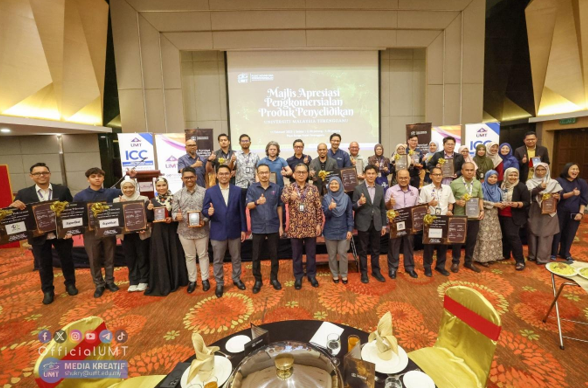
Universiti Malaysia Terengganu (UMT) has fully embraced this national agenda. The university has continued to foster a strong culture of innovation, ensuring that every research effort carries the potential to benefit industry and society.
A key component of this effort is intellectual property (IP) protection. UMT has successfully registered more than 800 IPs, a testament to the creativity and productivity of its researchers. These IPs are being prepared for monetisation through clear institutional policies and continuous awareness programmes that encourage researchers to prioritise IP filing and strategic commercialisation.
UMT’s commitment to industry partnerships has been equally evident. As at today, the university maintains 22 active licensing agreements with companies commercialising UMT’s innovations. These agreements have generated approximately RM18 million in revenue over the period 2024–2025 (2 years), demonstrating strong market confidence in UMT’s technologies. This level of engagement reflects a mature innovation ecosystem grounded in trust, relevance, and long-term collaboration.
To further strengthen the bridge between industry and academia, UMT has provided matching grants encouraging companies to work directly with researchers. Through this mechanism, industries may present real-world challenges that are then addressed through applied research and targeted technological development. Innovations produced through such collaborations are protected, commercialised, and eventually generate royalties for the university, ensuring sustainable income and meaningful societal impact.
UMT has also offered internal pre-commercialisation funds to help researchers progress from laboratory results to market-ready prototypes. This early support accelerates technology maturation and strengthens product viability before industry adoption.
Complementing this effort, UMT has encouraged researchers to establish start-up companies as commercialisation vehicles. Currently, UMT has 12 active start-ups, with the earliest established in 2021. Collectively, these start-ups have generated over RM1.5 million in revenue for 2025, marking a promising trajectory for the university’s innovation ecosystem. Start-ups serve as vital platforms for validating market demand, producing small-scale products, and attracting investors for future expansion. These strategic steps pave the way for scalable growth and eventually opportunities for public listing.
UMT remains committed to advancing impact-driven, innovation-led research. Through continuous training and entrepreneurship development programmes, researchers are equipped with the knowledge and confidence to commercialise their outputs.
By 2027, UMT aims to expand its portfolio by securing more than 30 licensing agreements and establishing 20 successful start-ups, strengthening its contribution to national development and Malaysia’s innovation landscape.
