Thursday, 27/6/2024
Share This Article :
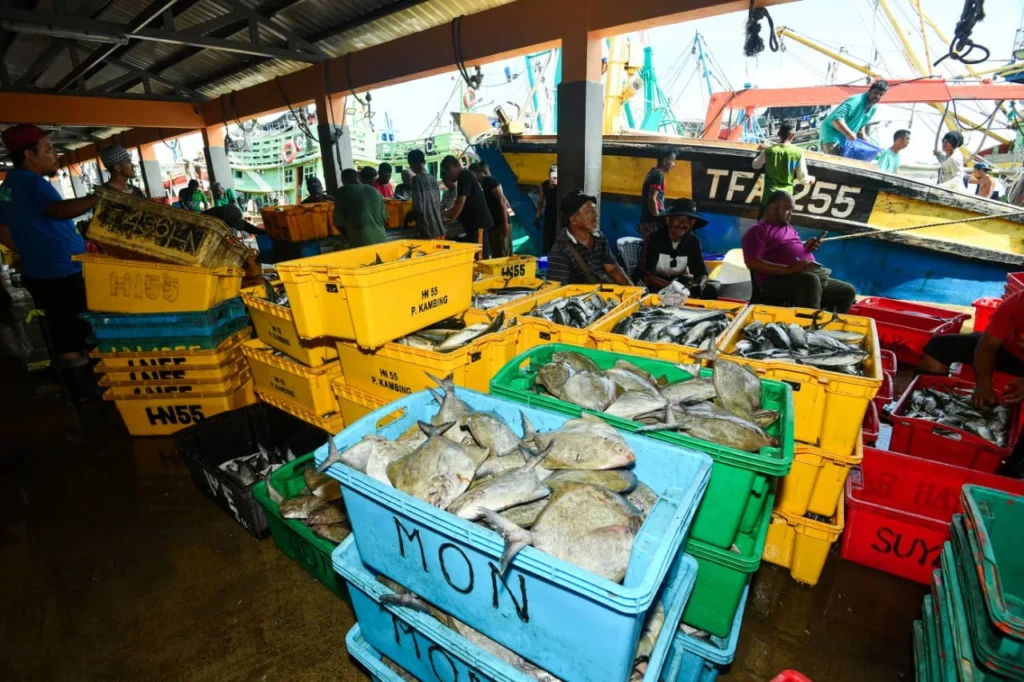
According to fisheries statistics, in 2011 the total marine capture fisheries was 1,328,041.14 metric tonne (MT), valued at RM10,802,826,870. In 2022, the total decreased to 1,308,415.08 MT, valued at RM11,306,367,618. The data showed that the quantity dwindled by 1.5% and the value rose by 4.7% compared to 2021. The distribution of fish landings by zone was as follows: Zone A; 34% (446,802 MT), Zone B; 25% (330,845 MT), Zone C;28% (372,857 MT), Zone C2; 12% (153,878 MT) and Zone C3; 1% (4,031 MT). The data showed that the coastal seas contributed 88% (Zone A to C) and the deep seas only 12% (Zone C2 and C3).
The dependency on coastal fish landings is very high compared to those of the deep seas. Zone A is also a buffer zone that is important for the sustainability of the fisheries resources. Specific fish species migrate to this area to breed during the peak hours. Small or juvenile fishes are also here where the rich food sources allow them to grow. The coastal areas have plenty of natural habitats that function as shelters for the fishes. Exploiting the resources here must be done prudently so that the fisheries stock will not be affected.
According to the Institute of Language and Literature, innovation means anything new, such as a new method. In the context of fisheries, innovation is important for the sustainability of resources. Fisheries resources are now affected by natural phenomena and are far from being sustainable. In addition, the natural habitats are being disrupted. There have been several techniques and methods used passed down from one generation to another. Innovations or modifications more or less can increase the sustainability of fisheries resources. According to fisheries statistics, in 2021 and 2022, a total of 229,722 MT and 242, 069 trash fishes were landed. There was an increase in 2022 and this showed that some of the fisheries equipment were too effective that it was impossible to separate bycatch and adult fishes. If this pattern of landing continues, fisheries stock will be affected, and resource leakage will occur.
To sustain the fisheries resources, translating research to the community is very important and the best solution to overcome scientific, social, and economic problems. The Centre for Knowledge Transfer, Industry and Community Linkages (PIJIM), Universiti Malaysia Terengganu (UMT), and the Ministry of Finance (MOF) have provided fund that focuses on innovation involving fish aggregating device (FDA) and fishing equipment to help sustain the fisheries resources. This two-pronged approach focuses on the scientific aspect and helps the main stakeholders, who are the coastal fishermen. The collaboration has been made possible with involvement from the Department of Fisheries (DOF) and the Malaysian Fisheries Development Authority (LKIM), which is responsible for closely managing the country’s fisheries stock.
Net mesh size, entry measurement, colour, material, and depth are very important in ensuring that bycatch is not accidentally caught. Fish size and maturity must also be considered despite high fish landings. If the captured fishes are small or immature, they are classified as trash fish, and the sustainability of the country’s fisheries resources will be affected. Therefore, continuous research and cooperation between the main stakeholders, such as the Department of Fisheries, Maritime, policy makers, fishermen, fund contributors, and researchers, are very important. Innovation or equipment modification must also consider several factors, such as seasons, abiotic and biotic factors, and habitat, while not neglecting the impact on the fishermen’s income.
Fish aggregating devices (FDA) and reefs are good alternatives to help revive fisheries habitats that have been affected due to various factors. FDA is a good solution for restoring the fisheries stock. There are several techniques, forms, and methods used to gather fish in a group with high density. However, the effectiveness of FDA is also dependent on the wealth of the oceans, materials used, oceans’ current, depth, and water clarity among others. The use of plant materials also makes FDA more attractive. In addition, Malaysia has an abundant of plants of various species. Each type of leaf used may attract different fish species if positioned at the correct depth. Each leaf has a natural scent, and breaks down into several different layers when submerged in the oceans. In fact, the leaves become home to natural fish food such as planktons and small fishes. The types of food depend on the types of leaves and the depth. If they are positioned at the demersal areas, they become home to high-value fish such as yellowfin grouper, golden snapper, or red snapper.
However, each innovation needs to be monitored from time to time to gauge its effectiveness. A little modification may provide a different impact to the country’s fisheries stock. Also, to produce good innovation, scientific and social monitoring is very important. For instance, to see the effectiveness of fishing equipment, fish sizes must be linked to the net mesh sizes. While for FDA, fish quantity and stock density can be monitored by using a scientific echo sounder. This equipment can help determine the quantity, size, and density of fish based on depth or per square metre. It can also be used to monitor up close the behaviour of fish towards the innovation.
Innovation will not succeed without support from all parties, and opinions of policy makers, the Department of Fisheries, the fishermen community, and other stakeholders need to be seriously considered to achieve success. Innovation should not be discontinued or take too long to be implemented in order to be effective for future generations. Modification or innovation may arise from stakeholders’ views, however small these views are.
Original version in Malay by:
Dr. Mohd Fazrul Hisam bin Abd Aziz
Senior Lecturer
Faculty of Fisheries and Food Science
Universiti Malaysia Terengganu
English translation by:
Corporate Communications Office
Universiti Malaysia Terengganu