
Universiti Malaysia Terengganu (UMT) continues to cement its leadership as a premier hub for marine science by driving high-impact international scientific collaborations aimed at addressing global climate and coastal challenges, and this was evident recently when UMT’s Institute of Climate Adaptation and Marine Biotechnology (ICAMB) brought a world-renowned expert into UMT’s research ecosystem.
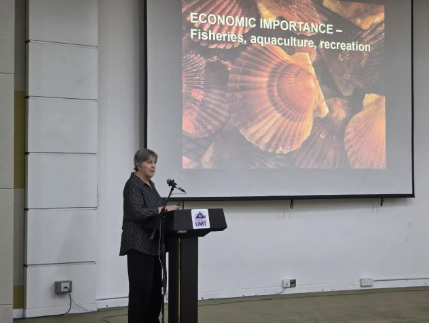
ICAMB invited Emeritus Prof. Dr. Sandra Shumway from the Department of Marine Sciences at the University of Connecticut to deliver a lecture during the Distinguished Scholar Talk session. Her talk was titled “Mitigating coastal eutrophication and CO2: Are filter-feeding shellfish the answer?”
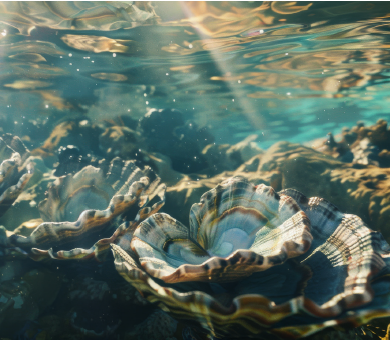
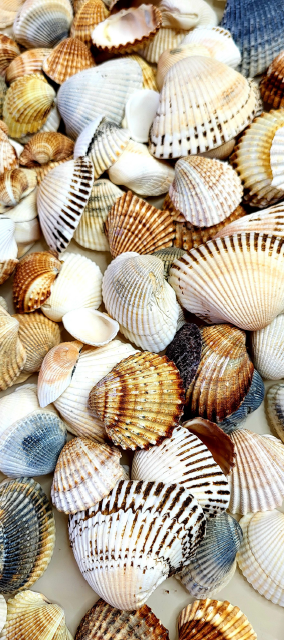
Addressing an audience of researchers, academics, and students, she highlighted nature-based solutions to some of the world’s most pressing marine environmental crises. Prof. Shumway emphasized the escalating threats of coastal eutrophication driven by excess nutrient runoff and rising global carbon dioxide levels. She presented compelling scientific evidence on the remarkable ability of filter-feeding bivalves, such as oysters, clams, and mussels, to act as natural bio-filters. By continuously filtering seawater, these shellfish absorb excess nitrogen and sequester carbon within their shells. This offers a sustainable, dual-purpose solution: producing valuable seafood while actively restoring degraded coastal ecosystems.
Building on these insights, UMT researchers actively engaged in strategic discussions to adapt the technologies directly into Malaysia’s marine ecosystem framework and coastal management plans.
Demonstrating the commitment to translation-driven science, ICAMB appointed Prof. Shumway as a Visiting Professor to work alongside local scientists. Together, the research team conducted advanced sampling and specialized training under the Higher Institution Centre of Excellence (HICoE) programme across UMT’s living laboratories on Redang Island and Bidong Island.
By attracting international scientific leaders to collaborate on its flagship research programmes, UMT continues to set the benchmarks for maritime and marine science in the region. This partnership reinforces UMT’s active role in shaping sustainable marine policies, fostering international innovation, and delivering high-impact solutions for Malaysia and the world.
by Arzura Abdullah
Institute of Climate Adaptation and Marine Biotechnology