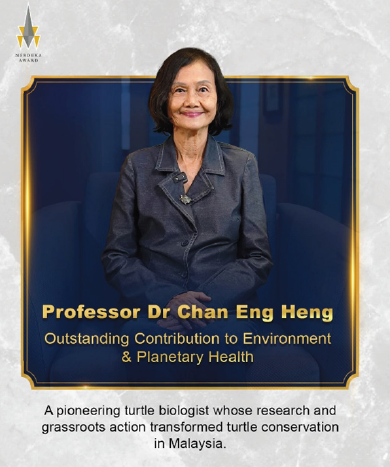
She spearheaded Malaysia’s first in-situ marine turtle egg protection programme and helped secure stronger protection for critical nesting grounds. Through her research and grassroots action, she transformed turtle conservation in the country, cementing her legacy as a pioneering turtle biologist .
When Professor Dr Chan Eng Heng received the 2026 Merdeka Award for Outstanding Contribution to Environment and Planetary Health recently, Universiti Malaysia Terengganu (UMT) celebrated more than the achievements of a former professor. It celebrated a legacy that remains active on Malaysia’s beaches, in its research programmes and in the careers of conservationists she helped shape.
Professor Chan’s work with turtles began in Terengganu in the early 1980s, when questions about
by Mohd Uzair Rusli, Sea Turtle Research Unit (SEATRU)
leatherback egg hatching drew a young fish biologist into a field that would define much of her life’s work. Together with Associate Professor Liew Hock Chark, she went on to establish the Sea Turtle Research Unit (SEATRU) in 1984. What began as a focused research effort became a lasting platform for science, conservation and public participation.
The decisive question was what research could achieve for turtles in the wild. At Chagar Hutang on Redang Island, the team could study nesting females at night while knowing that their eggs might be collected for sale the following morning. In 1993, SEATRU began a long-term programme to protect eggs where turtles laid them. It linked field observations to action: monitoring nesting turtles, safeguarding nests and giving hatchlings a chance to reach the sea.
That work demanded persistence as well as scientific skill. When an early source of corporate funding ended,
More than three decades later, SEATRU continues to show what a small research platform can accomplish when it is sustained over time. Its long-term records help researchers understand changes in nesting populations. Its field programme supports the protection of Chagar Hutang. Its volunteers, students and collaborators carry what they learn into communities well beyond Redang.
The scale of the results is striking. The Merdeka Award commemorative publication reports that SEATRU had protected about half a million eggs fromhuman consumption and released more than 400,000 hatchlings by the time Professor Chan retired in 2009. By 2025, approximately 1.15 million hatchlings had been released on Redang Island. Behind those figures are decades of patient monitoring and the commitment of people who returned to the beach year after year.
Professor Chan’s influence also extends through the researchers she mentored. Former students and colleagues have taken their training into universities, conservation organisations and other agencies, where they continue to advance research and protection for turtles and their habitats. In this way, SEATRU has produced more than findings: it has helped develop people able to carry conservation forward.
The wider landscape has changed, too. Terengganu’s ban on the sale of eggs from all turtle species came into force in 2022, ending their legal commercial sale in the state. That milestone reflects years of work by many researchers, conservation groups, communities and policymakers. Professor Chan’s contribution belongs within that collective effort: she helped build the evidence, public understanding and practical example that gave stronger protection meaning on the ground.
Professor Chan has retired from UMT, but the platform she helped build remains at work. On the nesting beaches of Redang, in the scientists who followed her, and in the continuing effort to protect Malaysia’s turtles, her legacy is still being written.
To learn more about Professor Chan’s legacy and the conservation work that SEATRU continues today, visit https://seatru.umt.edu.my/
by Mohd Uzair Rusli, Sea Turtle Research Unit (SEATRU)